
How Fiber and Iron in Dates Support Mums

The weeks after giving birth are hard on the body and the mind. There are tissues to heal and hormones to settle, and many mothers deal with low energy, constipation, anemia or a poor appetite along the way.
Food is part of recovery, and dates are one of the easiest things a tired new mother can eat. When talking about dates for mums, two nutrients usually come up: fiber and iron. Dates are a fair source of the first and a small source of the second, and that difference matters when you are recovering from birth. If you plan to eat a few a day for several weeks, buying by the box from a kurma supplier in Malaysia saves trips to the shop.
This article looks at how much fiber and iron dates actually contain, what NHS guidance says about both after birth, where dates sit in postpartum tradition, and how to fit them into daily meals. It is general information, not medical advice. If you are recovering from birth, breastfeeding, or have been told you are anemic, check with your doctor or midwife before changing your diet.
Understanding postpartum recovery and nutritional needs
Postpartum recovery involves physical repair and big physiological changes. Blood loss, hormonal fluctuations, muscle strain, and altered digestion are all part of the healing process.
Rest and emotional support matter, and so does food. Unfortunately, many mothers experience a lack of appetite, fatigue, or insufficient time to prepare nutrient-dense meals. This is where dates are handy. They need no cooking, you can eat one with a baby in your other arm, and they bring some fiber and a little iron. They are not a treatment for anything.
Fiber and iron get the attention because they relate to two common problems after birth: constipation and iron deficiency anemia. Knowing how much of each a date really gives you keeps expectations realistic.
Why fiber and iron matter after childbirth
To see where dates fit, start with what fiber and iron do after birth.
The NHS says fiber helps with digestion and helps prevent constipation. UK guidance is 30 g a day, while most adults manage only about 20 g (NHS, fibre). Constipation is common during pregnancy and after giving birth. The NHS lists too little fiber, too little fluid and not moving much among the usual causes. Its first advice is to increase fiber gradually and drink plenty of water, and to speak to a pharmacist about a laxative if diet changes are not helping (NHS, constipation).
Iron is needed to make red blood cells, which carry oxygen around the body. Women aged 19 to 49 need 14.8 mg a day (NHS, iron). The NHS says iron deficiency anemia is often caused by blood loss or pregnancy. Symptoms include tiredness and lack of energy, shortness of breath, heart palpitations, paler skin and headaches. It is treated with iron tablets and by eating iron-rich foods (NHS, iron deficiency anaemia).
Here is what dates actually contain. Per 100 g, USDA data gives Medjool dates 6.7 g of fiber and 0.9 mg of iron (USDA, Medjool), and Deglet Noor dates 8.0 g of fiber and 1.02 mg of iron (USDA, Deglet Noor). So 100 g of dates covers roughly a quarter of the 30 g fiber target, but only about 6–7% of a woman’s daily iron need. For more detail, see this page on the nutritional profile and calories of dates.
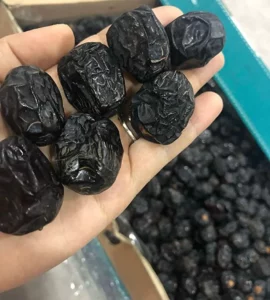
Fiber in dates and digestion after birth
One of the most well-known challenges mothers face after giving birth is constipation, and many women experience fear or discomfort when attempting bowel movements due to soreness, stitches, or hemorrhoids. The NHS advice for making poo softer and easier to pass starts with fiber and fluids, and dates can be one of your fiber sources.
We found no human trial that tested dates for constipation, after birth or otherwise (the only date study on gut transit we found on PubMed was in rats). So treat them as part of a higher-fiber diet, not as a remedy. Add fiber gradually and drink more water as you do. Our guide to keeping up a high-fiber diet has more everyday ideas.
Because dates are soft, sweet, and easy to chew, mothers who have difficulty eating large meals often find them easier to consume than raw vegetables or whole grains.
A 30 g portion of dried fruit, dates included, counts as one of your 5 A Day. The NHS suggests eating dried fruit at mealtimes rather than as a between-meal snack, to reduce the risk of tooth decay (NHS, 5 A Day).
Iron in dates: what they can and cannot do for anemia
Blood loss during birth can leave a woman short of iron even if her levels were fine in pregnancy, which fits the NHS point that blood loss is a common cause of iron deficiency anemia. If you feel unusually tired or breathless, or get palpitations in the weeks after birth, tell your GP or midwife. Anemia is diagnosed with a blood test, not by symptoms alone.
At about 1 mg per 100 g, dates will not correct anemia. If a blood test shows it, the NHS recommends iron tablets, usually for about 6 months, and says drinking orange juice after taking a tablet may help your body absorb the iron. It also advises having less tea, coffee and milk, because large amounts make iron harder to absorb (NHS, iron deficiency anaemia). Dried fruit is on the NHS list of good iron sources (NHS, iron), so dates can sit alongside that treatment as one small part of an iron-aware diet.
Dates are also energy-dense: 277 kcal and 75 g of carbohydrate per 100 g of Medjool (USDA, Medjool). That helps on days when meals get skipped, and it is worth remembering if you are watching your weight.
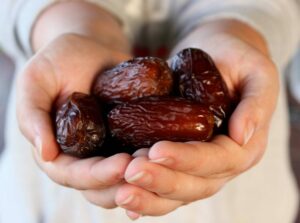
Dates in postpartum tradition
In many Muslim communities, dates are a traditional food for new mothers. A research team in Thailand describes date fruit as a popular natural galactagogue (a food believed to increase milk supply) among breastfeeding Muslim mothers (Modepeng et al., 2021).
Tradition credits dates with warming the body, strengthening the blood and helping milk supply. Of these, only milk supply has been tested in new mothers in a trial that we could find. In that study, 48 breastfeeding mothers of babies aged 1 to 3 months were split into two groups. The 25 who ate 10 dates a day on top of their usual diet produced more breast milk than the control group, up 11% from their own baseline at 2 weeks and 23% at 4 weeks. Their babies’ weight-for-age did not differ between the groups (Modepeng et al., 2021). It is one small trial, so read it as an early result, not proof.
Even today, dates remain a staple in postpartum diets in many cultures. The research so far backs their fiber content and one small milk-supply trial. It does not back the wider healing claims.
Dates, energy and mood after birth
Postpartum life is demanding both physically and emotionally. Fatigue, sleep deprivation, mood swings, and stress are common experiences. Dates will not fix any of that, but they are an easy thing to add to a meal when cooking feels impossible.
Most of a date is sugar, so the energy arrives quickly. That also makes dates calorie-dense, which matters if you are managing your weight or blood sugar.
How many dates should mothers eat after birth?
There is no official number of dates for new mothers. The NHS counts a 30 g portion of dried fruit, dates included, as one of your 5 A Day (NHS, 5 A Day). Weigh 30 g once with the dates you buy so you know what a portion looks like, because a large Medjool and a small Deglet Noor are very different sizes.
If you are constipated, the NHS approach is more fiber from a mix of foods plus plenty of water. You may notice a difference within a few days, though it can take a few weeks (NHS, constipation).
Dates go well with nuts, yogurt or nut butter. If you had gestational diabetes, the NHS says it usually disappears after giving birth, but you should have a blood test for diabetes 6 to 13 weeks after the birth and once a year after that if the result is normal (NHS, gestational diabetes). Ask your doctor or diabetes team how dates fit into your meals.
Easy ways to add dates to a postpartum diet
Dates are easy to work into meals. A few ideas:
- Add chopped dates to oatmeal or yogurt at breakfast.
- Blend dates into a smoothie with greens and citrus fruit (the NHS suggests keeping juice and smoothies to 150 ml a day in total).
- Stuff dates with almond butter or walnuts for a snack.
- Use dates to sweeten muffins or energy bites.
- Blend dates with oats and seeds for homemade oat bars.
- Cook dates into warm porridge or soup.
Because dates are soft, they require very little preparation, which suits busy mothers. They also store well and travel easily.
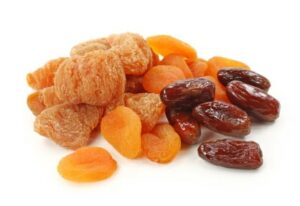
Other nutrients in dates
Dates also contain some potassium, magnesium and calcium. Here are the USDA amounts per 100 g of Medjool dates (USDA, Medjool), with what the NHS says each mineral does:
- Potassium, 696 mg, about a fifth of the 3,500 mg adults need each day. It helps control the balance of fluids in the body and helps the heart muscle work properly (NHS, other minerals).
- Magnesium, 54 mg. It helps turn the food we eat into energy (NHS, other minerals).
- Calcium, 64 mg, against the 700 mg adults need daily. It helps build bones and keep teeth healthy (NHS, calcium).
These are useful amounts, but none is large enough to stand in for a varied diet.
Conclusion
Dates are a practical food for the weeks after birth. Their fiber counts toward the 30 g a day that the NHS links with better digestion and less constipation. Their iron is real but small, far too little to treat anemia, which needs a blood test and usually iron tablets. One small trial found more breast milk in mothers eating 10 dates a day, which is worth knowing but is not a guarantee.
Eat them with meals, count them toward your 5 A Day, and keep the rest of your diet varied.
Used this way, dates for mums are a sensible part of a postpartum diet, not a cure for anything. For any health worry after birth, your GP, midwife or health visitor is the right first call.
References
- NHS. How to get more fibre into your diet.
- NHS. Constipation.
- NHS. Iron deficiency anaemia.
- NHS. Iron (vitamins and minerals).
- NHS. 5 A Day: what counts?
- NHS. Others (vitamins and minerals): potassium, magnesium; Calcium.
- NHS. Gestational diabetes.
- USDA FoodData Central. Dates, medjool (FDC 168191); Dates, deglet noor (FDC 171726).
- Modepeng T, Pavadhgul P, Bumrungpert A, Kitipichai W. The effects of date fruit consumption on breast milk quantity and nutritional status of infants. Breastfeed Med. 2021;16(11):909-914. PMID 34252286